How to read these figures
These estimates refer to different groups: the first includes people of all ages; the second concerns only people living with the conditions in question; the third refers to children and adolescents aged 0–19. They are not mutually exclusive categories within one sample. You cannot determine a person’s mental health by looking at them. The WHO European Region is not the same as the EU.
What does other research tell us about mental health in Europe?
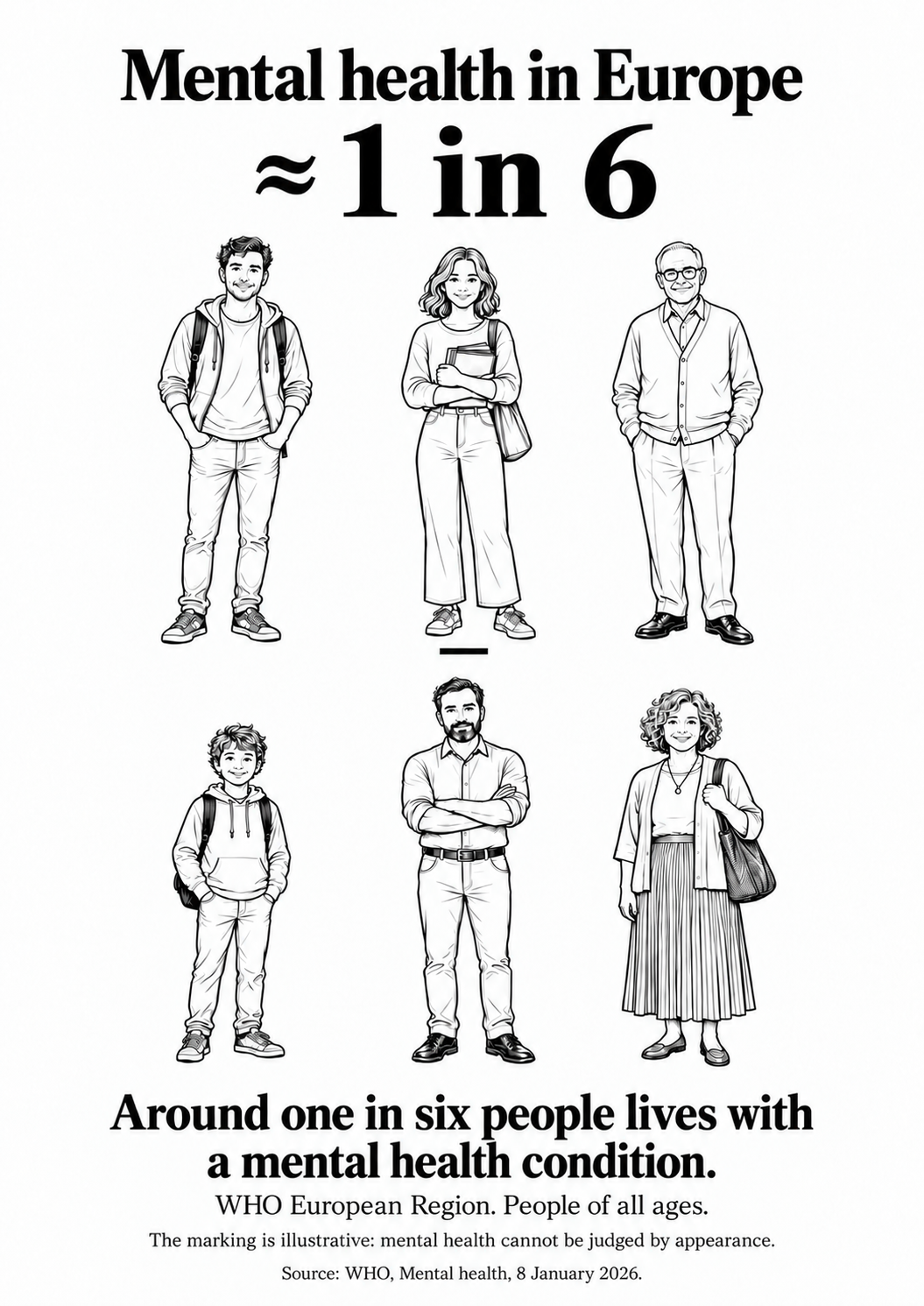
The three posters show different sides of the same issue. In January 2026, WHO reported that roughly one in six people in its European Region lives with a mental health condition. That is around 140 million people across all age groups. Conditions vary in severity; the estimate does not mean that every sixth person has received a diagnosis or that everyone needs the same treatment.
Are there other studies besides the WHO figures? Yes, although they often ask somewhat different questions. Eurostat, for example, found that in 2019, 7.2% of EU residents aged 15 and over reported chronic depression during the previous year. This was 0.3 percentage points higher than in 2014. That measure concerns just one condition, not every mental health condition. So 7.2% and “one in six” are not contradictory.
Another survey, Flash Eurobarometer in 2023, found that 46% of respondents in EU countries had experienced emotional or psychosocial difficulties during the year, such as feeling low or anxious. That is a much larger proportion, but it does not mean that nearly half the population has a mental disorder. Going through a difficult period, experiencing marked symptoms and living with a mental disorder are not the same thing.
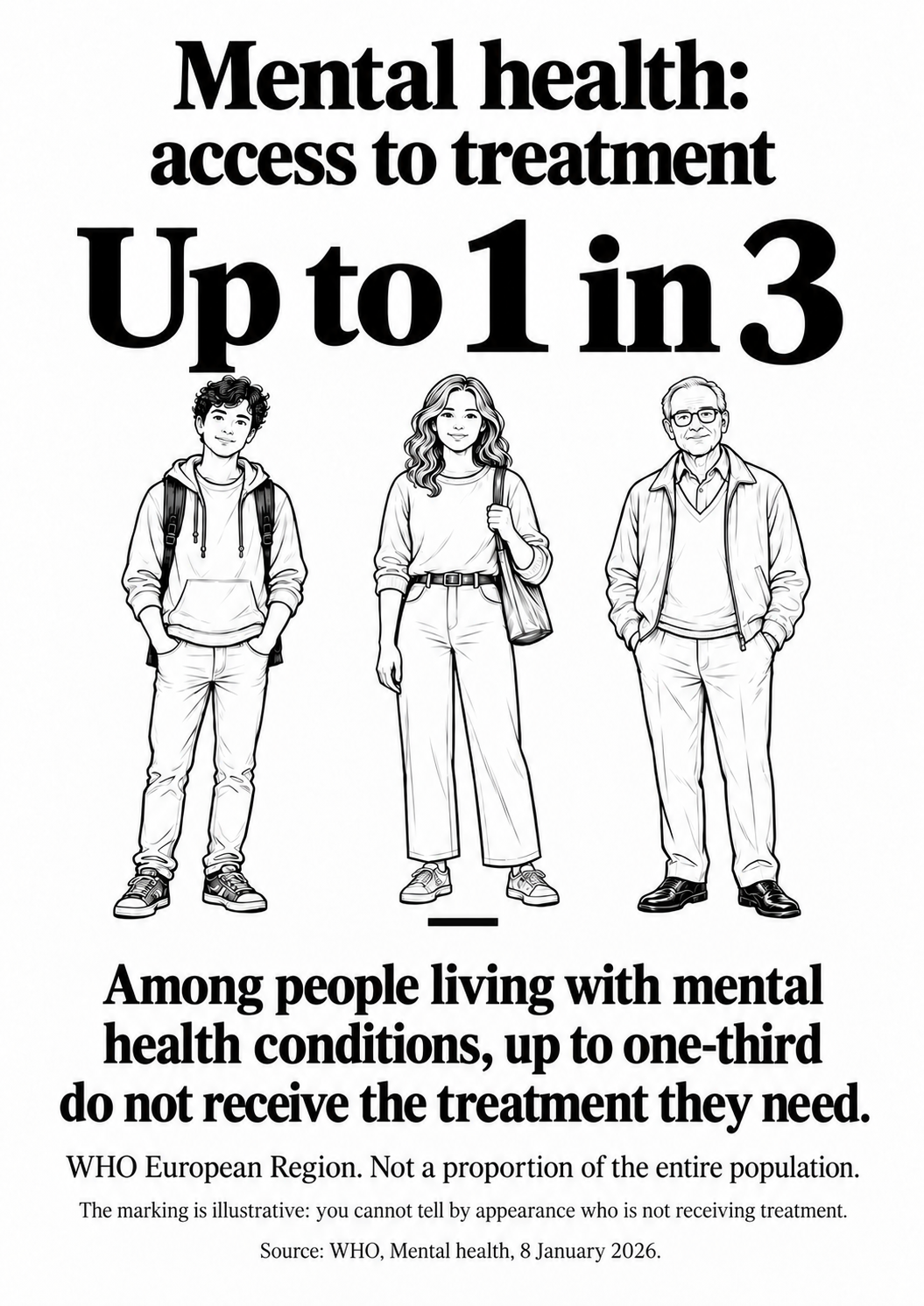
The second poster is about access to care. WHO estimates that up to one-third of people with the relevant conditions do not receive the treatment they need. Eurobarometer also highlighted gaps in support: 54% of respondents who reported a mental health problem had not received help from a professional. These results do not measure the same population in the same way: needing treatment and receiving professional support were defined differently. Still, both show that needing help and actually getting it are two different things.
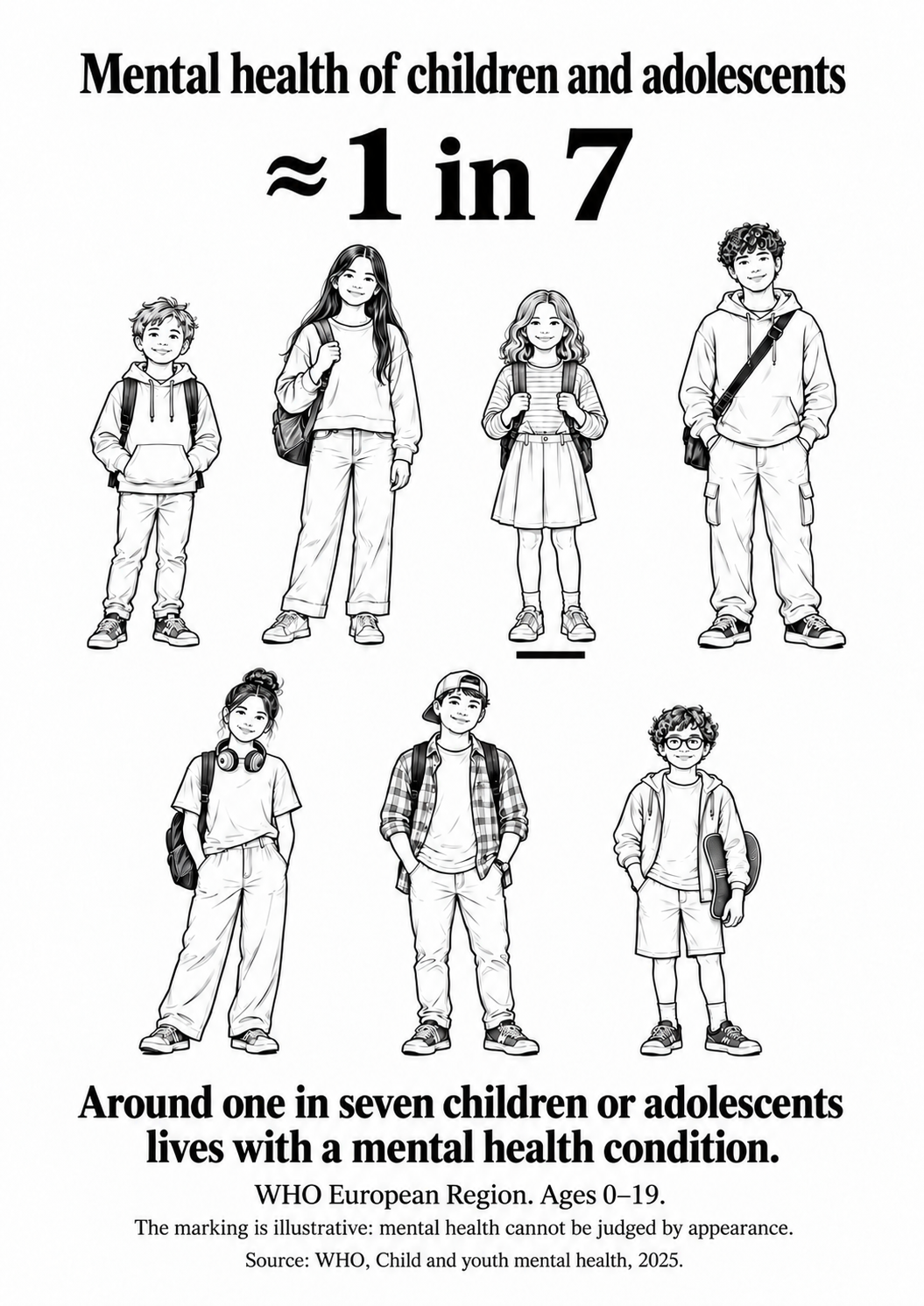
The third poster focuses on children and adolescents. A 2025 WHO report estimates around one in seven among those aged 0–19. The international HBSC survey adds insight into how young people feel in everyday life. According to OECD analysis for EU countries, the share of 15-year-olds frequently reporting several health complaints, including feeling low, irritability or sleep problems, rose from 42% in 2018 to 52% in 2022. That is a reason to pay attention to adolescent well-being, but such complaints must not be treated as diagnoses of mental disorders.
Why does one source say one in six, another 7.2% and yet another 46%? Because they measure different things: mental health conditions, particular illnesses, people’s experiences or their use of services. The WHO European Region is also much broader than the European Union, and the publication year may not be the survey year. These figures cannot be added together or read as one continuous time series.
Taken together, the studies paint a recognisable picture: mental health difficulties affect many people, children and adolescents warrant particular attention, and access to care remains uneven. The posters highlight a few important estimates; the other sources help explain what those estimates do and do not mean. And, of course, we cannot tell what someone is going through just by looking at them.
Materials for viewing and printing
The series includes individual PNG posters, a PDF and a PowerPoint presentation. WebP images are provided for quick browsing; the PDF loads only after a visitor requests it.
Licence for the project’s original materials: CC BY-NC-SA 4.0. WHO data are attributed to the original sources; this does not imply WHO endorsement of the project.
Sources
- WHO Europe — Mental health (8 January 2026)
- WHO Europe — Child and youth mental health (5 November 2025)
- Eurostat — Chronic depression in the EU, 2014 and 2019 (10 September 2021)
- European Commission — Flash Eurobarometer 530: Mental Health (2023)
- OECD / European Commission — Health at a Glance: Europe 2024, Adolescent health
- WHO / HBSC — A focus on adolescent mental health and well-being (2021/22 survey; 2023 report)